


Clinical Research Lucid Labs Editorial
They Lost Almost the Same Weight. What the Scale Missed.
Two groups in a 40-week tirzepatide trial lost around 22 kilograms each. A scan and a set of strength tests showed where their results differed.
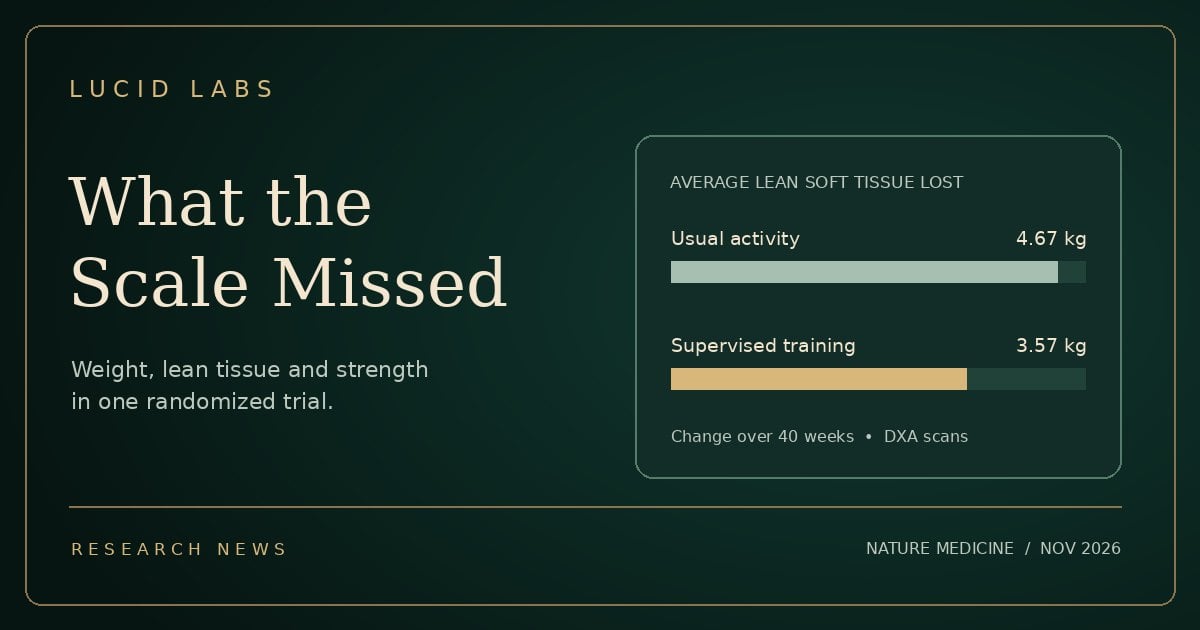
The scale told nearly the same story twice
One group lost an average of 22.61 kilograms. Another lost 22.28. If you had only those two readings, you might think the participants had much the same experience.
But a scan told a different story, and so did a strength test. The difference matters because a scale cannot tell you which tissue changed, much less what you can lift.
The researchers changed one part of the plan
In a 40-week randomized trial reported in Nature Medicine on November 9, researchers followed 120 adults aged 50 to 70 with overweight or obesity. Everyone received tirzepatide. One group kept up its usual activities; the other took part in a supervised resistance-training program. The trial asked what the training added, not what tirzepatide did compared with a placebo.
Scans showed an average loss of 4.67 kilograms of lean soft tissue in the usual-activity group and 3.57 kilograms in the training group. The estimated gap was 1.09 kilograms (95% confidence interval: 0.43 to 1.75 kilograms). Researchers did not detect a difference in fat loss between groups. That does not prove the fat loss was identical.
Why the paper does not say “a kilogram of muscle”
The scan, called DXA, groups body composition into fat, lean soft tissue and bone mineral. Lean soft tissue includes muscle, but also water and other tissue. Calling the full gap “muscle saved” would claim more than the scans can tell us.
The team also tested strength directly. On the bench press, lat pulldown and knee extension tests, average strength rose in the training group and fell in the usual-activity group. These were secondary outcomes and measured performance on those specific tasks, not every kind of physical function. Strength can improve even when the broader lean-tissue reading falls.
What remains unknown
This was one center, with initially sedentary adults and a closely supervised program. The trial excluded people with diabetes or cardiovascular disease, and participants knew whether they were training. It did not establish whether the differences last after the study, carry over to other medicines or translate into fewer falls or better day-to-day function.
What the trial did show is subtler than a dramatic before-and-after: the two averages on the scale were close, yet the composition and strength measurements told different stories. The answer depends on which question you ask.